Ten years from now we won’t need workers who do things right.
We’ll need workers who decidedly do things known to be wrong
in the pursuit of discovering the new right things to do.
This essay has three parts. It will first examine the economic threat posed by China to the United States from the perspective of agile software development, it will seek to explain how and why the current education system in the US is broken and lastly it will offer a set of suggested changes for revamping the current system to meet the threat and retain a position of relevance.Â
The True Nature of the Threat
Agile software development involves a “practical usage-centric” philosophy and an iterative approach to solving problems. Many of the concepts of Agile translate into non-software-related problem solving. One such concept is an idea put forth in Alistair Cockburn’s book regarding the cumulative effect of aligning many small force vectors precisely in one direction. Â The idea is that a software project involving multiple participants can be thought of as the exercise of dragging a large boulder from point A to point B. Â You can get a massive return by intermittently investing small amounts of energy to ensure that everyone is pulling in exactly the same direction. Â It’s best understood by this picture:
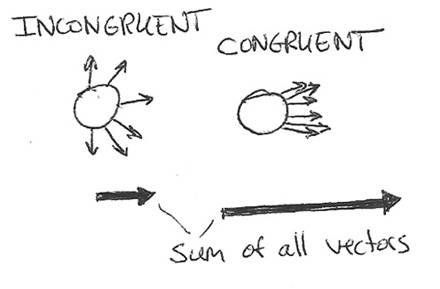 On the incongruent team, people have a general idea of the direction they should be pulling but they spend a good deal of energy tugging against one another.  On the congruent team, people are working from the same compass and are in near-perfect alignment. The resultant force is much greater. Note that nobody is pulling any harder than anyone else. All individual team members are pulling with identical force, it’s just that the congruent team translates that work into 5x the forward motion of the other team.Â
Now here’s where I’ll ask you to roll with a hypothesis: if you had to pin a US flag and a Chinese flag on the teams above, which team would be which?
One of the things that makes the US strong is its diverse culture, the difference of opinion in all aspects of life (heck the ability to challenge opinion at all), and freedom to do things differently. China on the other hand has a comparatively homogenous existence. I’ve never been to China and therefore only know about it from watching the Olympics but their culture seems fundamentally opposite to ours in this respect. Â Way less diversity, way less freedom to think differently, no ability to challenge the status quo or free markets to try competing ideas. Â What they lack in diversity however they compensate for in extreme team congruence and discipline. Every citizen there is groomed from birth to be aligned towards the cause of the government – and the ones who aren’t get squelched quickly.Â
The other factor that’s not accounted for by the above image is that their “team” is 4x as big as ours. Â The estimated population of China a year ago was 1.3BN people, ours was 300MM in the US. So quadruple the number of arrows on the diagram above for “team congruent” and see what effect that has on the resultant force- not only are they using their force more efficiently but they have more raw pulling power to being with.Â
So where am I going with all this? Â Before we get there, let’s look at our educational system.
History of our Educational System
The DNA of the US is one of diversity, risk-taking, opposition, conflict, creativity, free market forces and both spectacular failures and spectacular innovations. China is one of homogeneity, discipline, tradition, incremental improvements and predictability. If we’re a patchwork quilt that’s been knitted together over the ages from all kinds of different fabric, China is a pristine piece of galvanized steel:

That’s not to say one material is superior- just different. They have tensile strength but with it, rigidity and brittleness. Â We have elasticity and diversity at but at the expense of reduced congruence.
Looking at education though, our culture exists in spite of our educational system.  China’s culture conversely is a perfect reflection of theirs. It’s a miracle we still have the texture and sharp edges given the dulling grinder we run our kids through. To understand where the system has gone off the rails, let’s back up a bit:Â
The industrialized revolution created a demand for factory workers – drones who could operate machinery, take orders, follow instructions and perform a set of prescribed tasks repetitively and accurately. Â This was what constituted “work” back in the day. An educational system grew to meet the goal of generating the ideal worker for these conditions. Â Consequently the following educational practices emerged:
- standardized testing
- multiple choice answers
- a “hub-and-spoke” instruction from one teacher to many students
- asymmetric information exchange with students primarily absorbing info
- emphasis on memorization and adherence to convention
And that’s exactly what we needed at that time- it produced the intended result. Â
What’s changed since then though is that the jobs of significance now are not at all about being able to operate machinery in predictable situations following pre-established protocols. Those jobs are still available but they’ve been commoditized via either software automation or outsourcing. Â The skills that are now in demand are:
- critical thinking to determine what the real issues are
- problem solving that operates creatively under constraints
- effective communication in all realms (digital & in-person / written & verbal)
- persuasion, negotiation & the ability to inspire
- effective collaboration in teams

This is an entirely different set of skills. The legacy education system we’re running is purely an artifact of a time when we needed something else – we’re clinging to something that no longer suits our need sheerly because it’s the way it’s always been. Â It’s like the anecdote about the lady cooking at Christmas time. Her guest asks why she trims the edges off the ham in the oven and she says, “I dunno, that’s how mom always did it.” Conveniently the lady’s mother is standing there and when asked about the rationale for that practice she says, “I dunno, that’s how mom always did it.” Â Fortunately the grandmother is there in her rocker and when interrogated about this tradition of trimming the ends off the ham she says very matter-of-factly, “we had a small oven.”
Assuming the typical child starts in pre-school and then does K-8, high school and a four-year term at college that’s an 18-year lead time to mold him/her to join the workforce. That means if we were able to flip some magic switch today that revamped the educational system immediately, there’d still be students trickling out of that pipeline for the next 18 years at varying degrees of tainted mental programming carried over from the old system. Â
The Proposed Reform <ahem> Demolition
So it does no good shout doom & gloom without offering suggestions for addressing the issues. Â
If we can agree:
- that China represents the most formidable adversary to the US
- that they have more human and natural resources than we do and
- that the people of China are effectively more disciplined and galvanized than we are
the logical question becomes “what should we do about it?”  “Are we just screwed at this point?”  It’s no question we’ll lose our role of dominance, the question is will we retain a role of relevance?  I can tell you what we should NOT do- we should not engage in an impossible battle of trying to match them on the qualities at which they already excel. The philosophy of disruption espoused in books like the “Innovator’s Solution” says that we’d be silly to go head-to-head on that axis of competition; we’d be playing an endless, unwinable game of catch-up. The proper response here is instead to change the axis of competition itself  and play to their weakness (and our strengths). But that involves starting at the root of everything and retooling the educational system.Â
If you’ve bought into the arguments thus far, here is a set of practical, actionable steps I propose that would set things in motion for the better:
- Repeal “No Child Left Behind” – Contrary to its euphemistic name, NCLB is an atrocity. My mother was a public school teacher of twenty-five years and I have several friends who are currently teaching in the public school system.  This policy is more appropriately named “Everyone Kept Behind.” It shackles teachers and forces them to focus energy on the wrong things. I won’t delve into that diatribe here because it could be an entire post on its own.
- Abolish standardized testing – That’s right. Â Kill it outright. “Well then how do you measure performance objectively in that situation?” you ask. Â You don’t – life isn’t objective, it’s entirely subjective in nature. Â The impetus for having standardized testing is all about quantifying progress against some objective yard stick but what’s the point? Remember we’re talking about a ground-up overhaul to the entire educational system here – not a minor adjustment. The answer for performance measurement is you develop a peer-driven, market-based assessment. There is no concept of “teaching to the test” anymore – the test is the market which is constantly evolving so think of your performance rating as your personal stock price in that system.
- Redirect monies from the above two programs to a teacher reimbursement fund: A good number of teachers end up digging into their own pockets for things like classroom supplies. With already meager salaries they end up spending their own money to do their job. That or they do without the supplies they need to effectively do their job.  This is unacceptable.  Whatever money can be recouped by whacking the above two programs should be put in a kitty that’s divvied up amongst teachers struggling to pay for supplies.
- Develop students like trainers develop athletes: this is the core of the mental shift- we need to no longer think of a school as an assembly line factory that runs a student through set grades and subjects. We need to view it as a training facility where natural abilities can be discovered and amplified. A teacher’s role should be to help identify and elicit those natural strengths and then cultivate them. Sure there will be areas of concentration which each student gets (the current subjects like English, Math, Science, etc) but the teacher is more akin to Stubs in Happy Gilmore than the English teacher in Ferris Bueller’s Day Off.Â
- Break the interaction paradigm and make it like a dojo: In the martial arts students advance and then must take a role teaching the newer students in order to continue advancing. Â You always learn something with a deeper intimacy once it requires that you teach it to someone else. Â Schools must break the hub-and-spoke interaction model and embrace the notion of peer-to-peer learning.Â
- Learn to learn:Â With very few exceptions (such as memorizing multiplication tables) there’s little reason to focus energy on memorization-intensive exercises. Think “long division” – what happened to that skill? Â How many times have you used it? Â It’s not about storing answers in our heads anymore- it’s about knowing the tools and techniques to find answers at runtime. There’s a statistic floating around that there will be more information produced this year than all years of previously-recorded history. It’s not about loading kids up with data anymore- it’s about teaching them to find and use relevant data effectively (and to ignore irrelevant data). Â It’s about teaching them to question the underlying reason they’re looking for data in the first place and determine if they’re solving the right problem to begin with. Promoting pure memorization of facts is arguably detrimental at this point to one’s development because it ends up eclipsing and thwarting the absorption of the more important skill of learning to learn.
- Emphasize collaboration: Odds are whatever your career ends up being, you will wind up working in collaboration with others. Failing to nurture team collaboration skills early on is a crime. Unless you’re the Unabomber, there’s no way you’re not going to be working collaboratively with someone else to survive. Why is it we wait until college to have students doing group projects? Preventing elementary school kids from doing homework together It should be mandatory that they do it collaboratively.
- Encourage cross-cultural exploration: Every kid in grade school should become proficient in a second language and should attend an exchange program in college. There is simply no substitute for living on another part of this rock with a totally different culture of people for awhile.Â
- Tax breaks for teachers:Â If we can’t pay them more, we can sure as hell take less from them. ‘Nuff said.
- Appoint Kathy Sierra to the National Board of Education:Â I don’t know that she’d accept it but she should at least be invited to advise the US on education and she should be contracted to visit every major school system and do a seminar with the teachers on “Creating passionate students.” Her “help your users to kick ass” mantra should be engraved in the faculty lounge of every school in America. “Overcoming the suck threshold” should be the primary focus of every teacher – if you can get students to that point they’ll naturally propel themselves onward. If you lose them before that point, no amount of policy or program will fix the situation.
- Use available tech to establish better communication between teachers and parents:Â Ultimately parents are the biggest determinant of a child’s development. A teacher’s best efforts can be undermined by crappy parenting at home. Conversely your child can get stuck with an awful teacher and yet your involvement with their homework and motivation can salvage the situation. Â We have microblogging tools that could be easily implemented in schools to give both teachers and parents a frictionless, terse yet frequent way to communicate. Â A relationship initiated at a parent/teacher conference can be strengthened over the year via these simple tools.Â
- Establish transparency and accountability by putting all Federal and State education-related legislation in a wiki: We’ve been talking a lot about what happens within the schools but there’s a whole slew of forces acting on the school system itself. Think meta here. At the Federal and State levels of government we need to be able to “diff the changes” easily in a public fashion. And we need to be able to clearly see who made the changes.  There’s no reason all policy affecting education shouldn’t wind up in a wiki with every revision of every piece of content attached to a URL. Doing this keeps everyone honest and anybody to “inspect the source code” and call someone out publicly. If you make all policy exposed and addressable via URL, it gives any concerned parent with a facebook, twitter account or blog the ability to shine a spotlight on a dark corner and call attention to funny business.
- Hold a National creativity contests: Why on earth are we still televising spelling bees?  Seriously. It’s great to encourage proper spelling but if you’re going to heavily promote a national contest for students, promote a science fair or an arts contest or a creative writing contest.  Have them develop their own board game and then challenge others with it.  By glamorizing spelling bees we’re emphasizing the importance of memorization. Dumb. Dumb. Dumb. Glamorize creativity and collaboration.
Conclusion
If you had to boil this entire essay down to one suggestion it’s this: a cookie cutter, formulaic system will no longer work for producing the the workers we will need ten years from now. We don’t need coloring books with numbers we need a fresh canvass and Bob Ross with a fat palette of paints and an eagerness to work with students to cultivate their natural talents. I gave a five-minute talk at the first Ignite Phoenix awhile back on this topic and I still believe it’s the single, most fundamental shift in mindset we can make to keep the US a relevant world power going forward.
What do you think? Â I’m especially interested in the opinions of school teachers and administrators who have first-hand experience.



 We’re witnessing right now one of the most significant wrestling matches of our lifetime from a “what will be in history books someday” perspective. If you haven’t been following the developments with Wikileaks you really should, if for no other reason than failing to do so is like sitting court-side at the NCAA championship with your eyes closed. Take a moment and read about it (and preferably seek out multiple angles via non-mainstream channels). The short of it is this:
  “Fair and Balanced” ummm… no. This movie shows just how out of touch with reality the viewers of Fox News are. The film surveys viewers of various news networks and compares results to see if there’s a bias. The responses from Fox News viewers were incredibly warped. Interviews with ex-Fox journalists reveal the morning memos of how public opinion was to be perverted that day. Bill O’Reilly earns my nomination for most annoying human.
  This is a safari into the corruption around the Enron scandal. What’s most troubling and surprising about this one is how distributed the participation was. This wasn’t an isolated case of Enron employees behaving badly but rather a concerted collaboration between a number of major banks, power companies and the accounting firm Arthur Anderson (who had to re-brand as Accenture because their reputation was so irreversibly trashed). It blows the mind to see how far these guys took it. And the bleed over to another documentary on this list is equally crazy: the majority of Enron’s SEC filings were opportunely destroyed when WTC7 mysteriously collapsed.
  Possibly the most infuriating one of the bunch, this film interviews key insiders about the mis-management of the Iraq conflict. If you watch none of the other movies from this list, see this one. I won’t even comment on it because it merits an entire post.
  This film covers the voting scandal of the 2004 presidential elections. Gaping security holes are demonstrated on the Diebold voting machines and public election officials are interviewed. How Diebold is still in business after this snowjob is pretty amazing. And the fact they never conducted a recount in Ohio after finding clear evidence of tampering is just one big WTF.
  This is a sobering look at the USA’s dependence on foreign oil. The key takeaway on this one is that the graphs are divergent – not only is our consumption going up but we’ve crested the hill of how much we can extract and we’re now coasting down the other side with increasingly-dwindling reserves.
  This film deals with the commercialization and privatization of the delivery of the most fundamental natural resource for humans: water. It also examines the legality of companies like Coca Cola and Nestle bottling a resource they don’t own and turning around and selling it to people. On a positive note affordable
  Get to know this company because they’re going to own everything you eat ten years from now. This film explores the multi-national behemoth that’s trying patent the genomes of living organisms. “Frankenfoods,” falsified studies, Bovine Growth Hormone, genetically-modified foods, carcinogenic herbicides, “Round Up-ready soybeans,” intentional transgenic contamination, agent orange, monopolization of cotton trade in India- fun stuff. You gotta hand it to them for some masterful business maneuvers though – they hook farmers on a must-have competitive advantage via engineering genetically superior seeds that then require their herbicide and fertilizer to subsist. And then once in a community these genetically-modified organism (GMO) crops infect neighboring crops – a veritable
  This movie sorts through the inconsistencies and unexplained phenomena around 9/11. Whatever you believe about the 9/11 tragedy you should see this film. While I don’t buy that the last administration was competent enough to orchestrate something so complex, there are too many inconsistencies. The film’s creator actually started out with the intention of making a fictional movie however as he got further into the research he realized he was making a documentary.
  A look at the impact of fast food on health. Martin Spurlock eats McDonald’s for a month and every time he’s asked if he’d like to supersize his meal he has to agree. Interestingly enough my roommate posed this question the other day: “Should we have a fast food tax?” If you think about it it’s no different than the idea of using a carbon tax to put a price on behavior that’s harmful to our environment. Why not do the same thing with food we know to be harmful to our bodies (and consequently our wallets in the form of health care costs)?
  Michael Moore is annoying. No doubt. But if you can overlook his style and focus on the content of his movies he raises valid points. This film explores the brokenness that is our current health care system. HMO’s, lobbyists, insurance companies, big pharma – it’s a train wreck. And what’s worse is there’s a whole slew of passenger cars of baby boomers barreling down the rails. The system needs a “Hiroshima” – it’s beyond repair and can only be fixed by scrapping it and re-conceiving things from the ground up. We have intelligent people and advanced technology and could re-architect it to work in the interest of the patients it serves. The first thing that needs to happen though is abolish lobbyists and disarm the companies that have a financial interest in seeing it continue the way it is.
  This is an expose on the silent sabotage of the EV1 and other electric vehicles. Interviews with insiders at GM discuss the schizophrenic dynamics inside an organization that launched a product it never wanted to succeed. Solar and Hydrogen Fuel cells were essentially calculated misdirection to sabotage the electric effort. Most interesting about this film is the passion of the EV1 drivers who were willing to pay absurd money to keep their vehicles only to have them repossessed by GM and scrapped.
  This film explores the premise that “if corporations are entities that have rights like humans, what type of person would they be if they were alive?” They study the “personality” characteristics of corporations and compare what they find to the DSM-IV book of abnormal psych disorders. The findings: an entity that exhibits symptoms of extreme psychosis.
  This movie investigates the global warming crisis, makes you like Al Gore and subliminally compels you to buy a Mac. This film was actually the only one that did go mainstream. The most interesting fact from the movie is that no peer-reviewed journal has ever disagreed with global warming. I saw this shortly after reading Michael Crichton’s book, State of Fear, which among other things tried to
  A look at the constitutionality of the income tax. This was an eye-opener. The narrator conducts interviews with high up public officials and puts them on the spot to substantiate the constitutionality of the income tax. Not one of them is able to do it. At this point it’s so embedded in our psyche and essential to funding the activities of our Nation that it’s unlikely it could ever be ditched at this point. But it definitely has shady roots and was not something that was added legitimately to the Constitution.
  If you’re a Scrabble fan and you’re on Facebook, odds are you have the Scrabulous app installed. It’s really the only reason to even log onto Facebook anymore. Game play is slick – it blows away the EA version they just launched (actually I tried to play a friend using their beta and it paired me with a complete stranger). Anyways, if you’ve followed the