Subscribe

Search

Categories

Archives

Stuff

Photos

    www.flickr.com
    This is a Flickr badge showing public photos from legaltech. Make your own badge here.

Quotes

Doubt your doubts and believe your beliefs.

-Switchfoot

View Sean Tierney's profile on LinkedIn


Passive Aggressive Advertising

January 9th, 2008 by sean

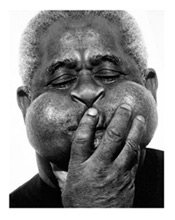
A thought occurred to me this morning while I was swishing mouthwash before heading out the door. All the commercials you see for Scope and Listerine show these people taking a giant gulp of mouthwash and swishing it around with cheeks puffed out like Dizzy Gilespie (watch for it next time, it’s pretty funny). And my inclination is always to take a big swig. In reality though, it takes exactly one sip of mouthwash to achieve the same benefit (probably 1/10th of what they show in a commercial). It’s obviously in their best interest, however, that you take a huge pull so you buy another bottle in 2wks.

Of course we plant similar mental seeds when we point out that JumpBoxes are so inexpensive and easy to use, you might benefit from getting multiple apps even if you came in search of only one. We also plant the seed that “you’ve discovered something unique which represents such a productivity boost and value in time-savings value, why not get an extra one and surprise a friend with it as a gift?” Guilty as charged of planting seeds and yet it’s different in that there is genuine value in what we propose vs. the idea of encouraging over-consumption of an exhaustible item to increase the frequency with which you must replace it.

What other instances of “passive aggressive” advertising in commercials and ads have you noticed?


Book Takeaways: Made to Stick

September 30th, 2007 by sean

The book Made to Stick by the Heath brothers, Dan and Chip, is a safari tour of the elements of effective messaging. What is it that makes certain ideas resonate and survive while others immediately fade? Not surprisingly, the messages from the book themselves stick well and there were a ton of great stories with nuggets of insight in each.

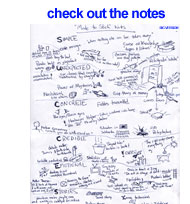
Rather than try to hash through everything in a long post as I did with Buzzmarketing, I figured I’d try a different approach. I captured the notable stories on a single page via doodles that trigger a memory of each story and its meaning. I’ve scanned that page and created an image-mapped graphic with a text snippet summarizing each insight.

The most interesting takeaway for me in reading this book is a “meta” realization that came not from anything particular within the book but rather from thinking about this book in relationship to other marketing books I’ve read (Anatomy of Buzz, Buzzmarketing, Freakonomics and Tipping Point). A discussion of that relationship merits it’s own post but the critical insight here is that for a message to be re-transmitted it must first stick with the recipient. The achievement of the sticking factor is a prerequisite for buzz-worthiness to ever be possible (ie. a virus endowed with traits that make it highly contagious will have zero effectiveness if it can’t survive within the host long enough to be spread).

The takeaway is that we spend a great deal of energy trying to spread the word when we would be better served to improve the longevity of the word for the people that it reaches. It’s not what you come away with that ultimately matters- it’s what stays with you over time. Along the lines of a post I wrote awhile back called “If an elevator pitch falls in the woods…” - the weakest link of the re-transmissability of a message is its stickiness, not its buzz-worthiness. The notes I drew up from reading Made to Stick are mostly for my own edification of these concepts and to have a reference for the future, but hopefully you find them useful as well.


The “post-tropical vacation blues” hypothesis

January 7th, 2007 by sean

People that come back from tropical vacation spots occasionally report mild depression upon returning to civilization. The generally-accepted cause seems to be that our society has become materialistic and disjointed. I have a different hypothesis as to what might be the true cause and it has nothing to do with flaws in the congruity of life in big cities.

The trouble with being given a spotlight is that you start to behave the way you think someone in a spotlight should behave rather than continuing with your own voice that got you there in the first place. Granted, this will be breaking my first New Year’s resolution of ditching the first person tense for posts but the realization I had after consulting a very wise woman is that ultimately blog writing is about connecting deeply with others and has nothing to do with tense usage and choice of grammar or even subject matter. If you can write something that resonates deeply with one person, that’s far more important than appealing shallowly to a ton of people. It matters only that the writing stem directly from the center of your chest as opposed to the top of your head. So I want to first tell a story and then suggest an idea for a thesis or dissertation to any graduate student of the behavioral sciences who might be qualified to test this theory and is looking for good fodder for a dissertation.

caboLandsEnd.JPGA friend of mine, Jeff Hausman once said to me upon returning from an extended vacation in Thailand, “Why is it that I feel so depressed by all this concrete and the pace of things here in the US- what are we doing??”

You really have to know Jeff to appreciate this statement. He’s the owner of VanHalenStore.com. I’ve known him since 1997 and he is the largest online retailer of Van Halen merchandise in the world and formerly produced Inside Magazine, the exclusive Van Halen fan magazine (this makes him one of the coolest people ever btw). He is one of the rare people that has made a living doing exactly what he loves and he’s been successful not because he is a genius at marketing or online sales, but because he is arguably VH’s biggest fan and believes in what he sells. Anyways, in October of 2000 he convinced four of us to drive with him from Phoenix to Cabo San Lucas. It was a round-trip of nearly 4000 miles that took three days of straight driving each way on some of the narrowest, most treacherous roads down the untamed Baja peninsula.

And it was a pilgrimage of sorts for all of us - Benny, Brad and I had just come out of working for a company called ProScout. Avery was in a transitional phase at Nortel and Jeff was flexible through the nature of his business to be able to take two weeks off and go to Mexico. The moons that were each of our lives were in proverbial alignment to facilitate this trip and it felt like one of those Stand By Me-type transformational voyages we all needed to take.

CaboArrivalAtOffice.JPGThe trip was in every way an epic adventure. We saw terrain and people that few others will ever see. When we finally arrived in Cabo we pulled up to this beach bar called “The Office” (still fresh out of our cube farms, the irony was laughable). We promptly grabbed a metal bucket of coronas, filled the bottom 1/3rd with sand and floated out into the ocean bobbing up and down on the swells that rolled in off the Pacific. It is a gem of a memory I keep tucked away and to this day draw upon it in moments of great stress.

Mexico is a “heat sink for stress” - it melts it away and puts even the most neurotic person into a relaxed state of mind. Mexican locals in the towns we visit don’t know the meaning of hurriedness there. The rest of that trip we spent lounging on Land’s End, taking water taxi’s, sea kayaking around the point, playing guitar and talking about the things that good friends can talk about under the stars in a foreign place. It was epic and it unwound us all.

caboWaterTaxi.JPGLike all amazing journeys though, it had to come to an end. We were there for twelve days and on the final day (once we had convinced Brad that he could not in fact smuggle the stray puppy that he had found back to the States), we guided Jeff’s Bronco onto Interstate 1 and began the long drive back up the Baja to Phoenix. We each took something different from that trip but what was consistent for all of us was the grounding effect of extracting ourselves from the rat race, transplanting to a seaside town and putting life in slo-mo for awhile.

Upon re-entering the States, Benny Brad and I took desk jobs, Avery returned to his Nortel cubicle and Jeff to his basement. Subsequently, each of us experienced a period of depression as we re-integrated to the concrete sprawls of our respective hometowns, Phoenix and Dallas. We talked about it and tried to put our finger on the cause- the conclusion we all came to was that it had to do with temporary shelter in a responsibility-free, stress-free environment and snapping back to the reality of the grind of daily work in a more-material-oriented society. With hindsight having made several extended trips to various seaside towns in Mexico since, I have a different theory to explain the depression and it is as simple as this:

When your body acclimates to a tropical climate (humid and fresh sea air) and a healthy diet (organic produce and mainly seafood with high concentration of OM-3 and OM-6 EFA’s), abruptly transplanting to a locale with poor air quality, zero humidity and a EFA-deficient diet causes jarring changes in one’s chemistry and effects manifest as depression. We mistakenly attribute the resulting lethargy to the hustle & bustle and materialism of our home surroundings and ponder whether the US is going to “hell in a hand basket.” I’m suggesting that the depression can be attributed to simple Pavlovian classical conditioning with the body chemistry changes being the true culprit and us subconsciously pairing the stimuli of our home surroundings with the behavioral response we experience from the chemistry change. If this is in fact correct, then the effects can be easily mitigated with an air purifier, humidifier and dietary supplements to approximate the tropical environment.

CaboBungalow.JPGAnyways, that’s the gist of my theory. Of course I have no scientific basis to substantiate any of this but it’s a best guess based on past personal experience and could be fairly easily tested with control groups. It would be great to see some grad student pick this up and do it as a dissertation - I will gladly volunteer to be one of the subjects if needed ;-)

I throw this out there because depression is an ugly thing and I have personally brushed with it on multiple occasions and would love to get to the bottom of what causes it. If you’ve ever experienced the “Post Tropical Vacation Blues” - leave your story here in a comment and maybe a medical researcher will latch onto this idea and test it. The bottom line- by chronicling your experiences, your physiology and the relevant variables, patterns will emerge that give clues as to the true underlying causes. Cheers to a depression-free world and to the day that mental conditions are understood with the same clarity as physical illnesses.


Innovation Games: an important book for anyone seeking to improve a product or service

June 27th, 2006 by sean

innovationGamesBook.jpgSix months ago I was contacted by the publisher Addison-Wesley and invited to review a manuscript for a book called Innovation Games by Luke Hohmann. I just noticed they’re now accepting pre-orders on Amazon. While I’m still bound by the the review agreement and restricted from discussing particulars of the book, I can give a general overview and say that this will be an important work for anyone who strives to elicit the purest feedback and forward-thinking suggestions on the development of a product/service. First let’s look at the problem Luke is addressing.
Anyone who has conducted a focus group or a psych experiment knows that as soon as you ask someone for a justification of a decision, the mere act of asking them to explain things can cause them to change their response to fit the justification they think you want. Malcolm Gladwell covered this phenomenon in depth in his book Blink and perhaps the most memorable he cites is the experiment where a bunch of college students were offered a selection of posters for their dorm at the beginning of the year. The only condition of the experiment is that they had to keep the poster on their wall for the rest of the semester. Most of the students ended up choosing abstract art pieces (almost none chose the cutesy “kitten with a ball of yarn”-type posters you see in doctor’s offices). The experiment was repeated with a new group only the next time around the students had to justify their decision for the poster they chose. A great majority of the students ended up picking one of those rainbow, kitten, motivational posters and attributing their choice to the “cuteness” of the poster. The funny thing is a satisfaction survey conducted at the end of the semester showed that nearly all the students from the second group that had chosen the kitten posters HATED their poster and most had taken it down while the students that had never been required to justify their choice were still content with their selection. So how does this relate to Innovation Games?

Focus groups experience this same inherent flaw: the act of soliciting feedback from participants on a product often causes them to return skewed results laced with things they think the researcher wants to hear even when there is no tangible reward for doing so. It’s almost as the “wave particle duality of light” dilemma of Schrodinger’s Kittens occurs in human subjects in that the very act of measuring changes the thing being measured. So how does one get accurate feedback when the process of collecting data spoils the data itself? Luke proposes a simple yet clever device for eliciting the untainted feedback: couch the “experiments” in the form of games. I won’t steal his thunder and list all the games here but he proposes twelve different games which can be played in small groups over the course of an afternoon and are designed to extract innovative ideas and unadulterated feedback on how to improve a product or service. Playing these Innovation Games achieves a couple things:

  1. It makes the solicitation of the feedback implicit rather than explicit therefore nullifying the Hawthorne Effect (*note the Hawthorne Effect has been contested and yet continues to manifest primarily in educational experiments).
  2. It removes the experimenter bias because instead of potentially leading questions from an interviewer, you have pre-defined rules of a game that is played amongst participants
  3. It makes the experiment itself a more pleasurable activity and therefore improves the likelihood that participants will actively contribute as much as possible.
  4. It encourages creative thinking and produces interesting artifacts that can be analyzed and quantified later rather than bottle-necking the available responses up front to multiple-choice questions on a survey.
  5. The games -specifically Buy a Feature, Prune the Product Tree and Speed Boat- draw upon the power of decision markets (more on this in a forthcoming review of The Wisdom of Crowds)

I recommend this book to anyone that has the task of conducting a focus group for his or her company and for anyone with access to potential customers who would benefit by innovating around an existing product or service. My only criticism of this book is that after reading about how to conduct all twelve games, it was difficult to remember individual games later and when it was appropriate to use each. I lobbied for Luke to produce a supplementary DVD that showed concrete examples of past games conducted at his seminars with the thought that doing so would help cement the abstract ideas with real imagery and therefore facilitate better recall of each. I do not know whether they plan to release such a DVD but hopefully they will at some point. It’s not critical that you remember the specifics of the games from memory (you can always reference the book) - it’s more important that you understand the relevance of each game and be able to identify situations when it would make sense to employ a game to extract meaningful insight. You can read more from Luke on his blog or via his company’s website.

It should be noted have no affiliation with Luke or his company. I received a small, one-time honorarium from Addison-Wesley for reviewing the manuscript but I realize no future financial gain from the success of his book.

UPDATE 5/8/07: Full disclosure: I do now have an affiliation with Enthiosys, Inc in that I am now a certified Innovation Games facilitator and qualified to deliver the games.

UPDATE 8/30/07: Big thanks to Bridgitte Kaltenbacher for pointing out that the reference doesn’t actually appear in Blink. I mistakenly attributed it to his book but it actually appears in his talk at Poptech a few years back. That MP3 can be found here and the reference starts around 23:10.


Why mindmapping works

June 7th, 2006 by sean

Disclaimer: I have zero scientific evidence to substantiate this theory. It’s subjective and anecdotal from my own experience and based in part on the concepts proposed by Tony Buzan in his Mindmapping book. Although I have no proof, I have seen it validated consistently through personal experience.

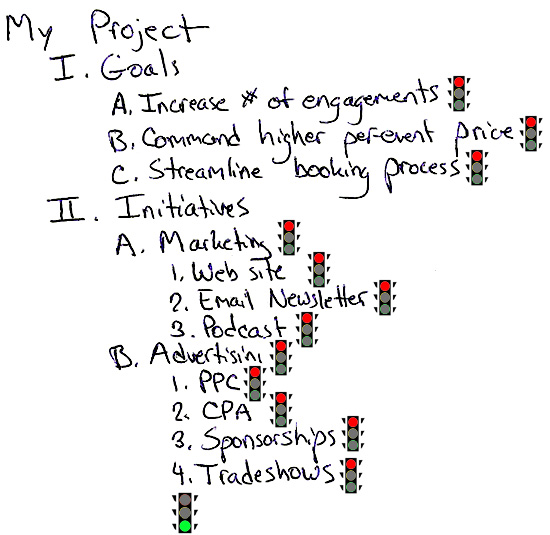
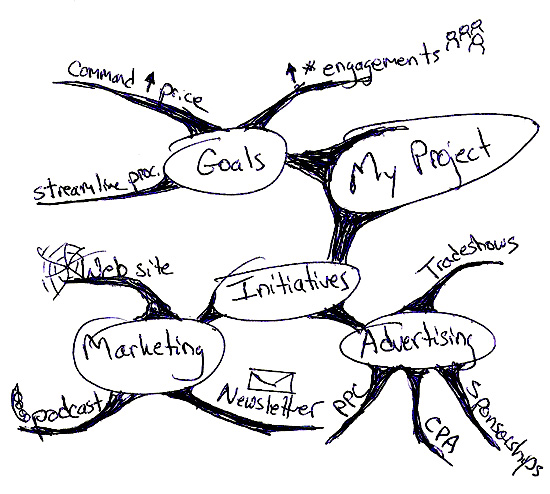
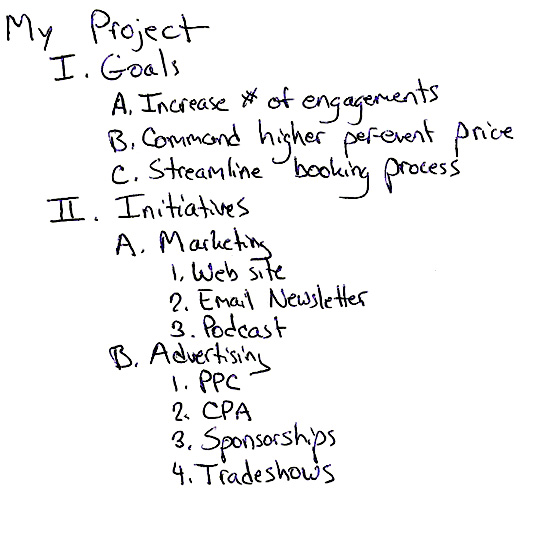
So why use a “tree-branching” style vs. a traditional outline format when brainstorming or note-taking? Very simply: because the conventional “indented outline” format of note taking imposes false linearity on your thought process . And what could be more important than having unbounded thinking when brainstorming or capturing notes on a new subject (I’m hereby banning the use the term “outside of the box” thinking). The Buzan book is the seminal work on mind-mapping and goes through a lengthy explanation of why and how to do it. I won’t rehash all that here but the main idea is that nature itself is not linear. Imposing a format on note taking which demands that we add new items sequentially to the outline funnels our thinking down to the last item at all times so that when we write this:

Outline: what you see

our brain is really seeing this:

Outline: what your brain sees

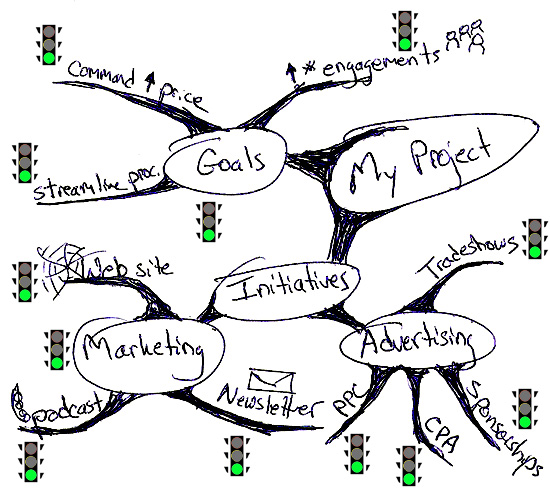
Using the alternative mindmapping technique, we can represent the same information like such:

Mindmap: what you see

And now our brain is instead seeing this:

Mindmap: what your brain sees

…which is good because we inherently like to fill in all the blank spaces and grow the tree so now rather than have the compulsion be to stop thinking about additional ideas, the path of least resistance is for our brain to continue to add to it. And once that spiral begins, tangential thoughts spawn from others and you start to get light bulbs. At least that’s the gist of why I believe it works. Granted for proposals and formal documents where the expectation is a more traditional representation, mind maps may not be appropriate. But at least the first time you begin thiniking about a subject for your own notes you should not be trying to cram the info into an outline. Doing so just because your fifth grade elementary school teacher told you it’s the proper way to outline a subject is pointless. Instead of getting hung up on where to use roman numerals vs. arabic vs. capital and small letters to ensure proper structure, we should be thinking how to remove the structure altogether from the notes and let them flow and grow organically.

The other benefit aside from improved creativity at the time of conception is greater retention and recall down the road. Try this test- look at the first outline above for 10sec and then go to a blank sheet of paper and write as much of it as you can remember. Now try the same experiment with the mindmap and see how much of it you were able to recall. The effect is amplified when you are the one generating the mindmap because you personalize it. The more doodles and weird stuff you make, the more visual your map becomes and we all know that “a picture is worth 1000 words.”

It’s one thing to read about mindmapping and say “hrmmm, that’s interesting,” but until you actually start doing it, it is just apriori book knowledge and you won’t fully appreciate the technique. As far as software, I can’t endorse any particular one as being better. I use one called Visual Mind and my friend Dave uses one called Mind Manager. There are no less than ten packages out there that all do the same thing and there are plenty of opensource options available and most of them can export the maps to XML and some integrate directly with wiki’s and pda’s. The best advice if you’re not mindmapping yet is to just try doing it and see if it doesn’t FEEL like “mentally cleaning the windshield” when you do exploratory thinking on a subject.


Pluralistic Ignorance

March 26th, 2006 by sean

is a fancy term for the phenomenon that explains the bystander effect. I first learned about it a year ago when I read a book written by a local ASU professor called Influence: The Psychology of Persuasion. Of all the interesting ideas in that book, I’ve seen this one confirmed at least weekly in my own life and as recently as yesterday. In an emergency situation, understanding the concept of pluralistic ignorance, the bystander effect and how to slice through them could prove life-saving.

The extreme example that illustrates the concept of pluralistic ignorance (PI) is the 1964 murder of a woman in NYC. This lady was stabbed to death in broad daylight over the course of two hours and the act was witnessed by no less than forty bystanders, yet nobody did a thing to intervene. Understandably, there was a huge stink in the media following the murder- "how could forty people let a gruesome event like this occur in plain view?" The conclusion at the time was that clearly society was in decline and people were simply becoming apathetic to others’ problems (?!?). Subsequent research, however, supported the PI theory that in situations where one is confronted with uncertainty, he/she checks the reactions of peers for cues on how to respond. When other bystanders exhibit calmness, the observer that thinks he/she is the only one who finds the situation disturbing reserves those doubts internally and expresses false calmness to fit in. Strange self-feeding anomalies like the NYC murder can occur because this "groupthink" pseudo-acceptability perpetuates itself amongst observers and actually strengthens the effect as more people join in.

Just yesterday in boarding a SWA flight on my way home from Lake Tahoe I experienced this effect firsthand. I was engrossed in the final pages of the latest Michael Crichton thriller and had missed the announcement for my section to board the plane. It was a full flight and when I looked up there was still a ton of people directly in front of me and I couldn’t be sure if my section had boarded already. I grabbed my gear and rushed to the group of people in front of me if they had already called the "A’s." About eight people must have turned around and just stared at me- not one person responded. It was an awkward moment returning the blank stares of these folks. Remembering the PI effet I raced over to a different line and singled out one guy and asked the same question. The people with him turned first towards me and then towards him and he immediately responded that they had in fact called the A group already. While this was clearly not a life-and-death situation, it does demonstrate an important lesson:

My TakeawayIf you ever find yourself in an emergency situation and need immediate help from a bystander, resist the temptation to call blindly on a group of people for assistance and instead meet the gaze of one person, single that person out and call upon them for assistance within earshot of the others. Intuitively it would seem that the shotgun approach of calling on a larger group would yield more likelihood of grabbing someone’s attention, however, it has the opposite effect of setting stage for this abdication of responsibility to occur. By singling one person out publicly, you put the PI effect to work for you and create a situation where that person is now center stage in front of the others and at the very least will respond with concern and consequently generate more concern in the observers. This causes a self-feeding positive spiral that you want to occur. What’s interesting is that there is this focal point that is the reaction of observer #1 that is the fine line between a downward spiral towards complete apathy of the other bystanders vs. an upward spiral of a convergence of many people trying to help. If there’s a side you want to err upon in a crisis it’s clearly the latter and understanding the PI effect can be critical towards creating that response.

© 2005 Lights Out Production - All Rights Reserved Worldwide


« Previous Entries