May 17

Rob Brooks-Bilson just posted on a topic we’ve been discussing in the office lately: the sterility of 99% of the food options in AZ, the idiocy of the food reviewers and how to find the true gems that are out there (because there are some gems). I know Rob from back in the day having run the local CFUG. Rob is an accomplished chef, a bright technical mind and he authors the “Foo(d) Bar Blog,” a great food-focused blog. I respect his food opinions immensely and couldn’t agree more with his post.

<begin AZ food rant> The Ahwatukee Food Review that Rob mentioned seems to be either “advertorial” or just ignorant. The fact that Oregano’s won 11/33 awards is asinine. I don’t know enough about the Ahwatukee publication to speculate but I’ve seen other reviews by New Times and AZ Republic that seemed to blur the lines between legitimate editorial and advertising. The peoples’ choice “Best of Phoenix” always seems pretty shady as well too- that or we Arizonans are just clueless when it comes to picking good food. I spent the month of November living up in SF and coming back to AZ was like returning to culinary sensory deprivation after being on a food furlough program. Don’t get me wrong- I like AZ. I grew up here and I’m still living here. But our food in general is completely pasteurized and lame. It’s like what you’d eat if Walmart, Clear Channel and Microsoft got together and threw a dinner party.

What Rob made me consider though is “how much of this lameness is perpetuated by reviewers promoting crappy places and then people recommending them because they don’t know any better?” Food is one of those things like music where the best discovery vehicle is usually a recommendation from a friend who has good taste. But when you don’t have exposure to good stuff, you recommend what you know. You turn to reviews and eat the blah crap that chains can afford to promote and then tell your friends how good the Olive Garden is. In the interest of averting the extinction of the few undiscovered restaurant gems that are hiding around Phx Metro, we should figure out a better way to promote them. One of my favorite Chinese restaurants just closed down presumably for lack of business- everytime I went there it had one or two other people eating there. They weren’t good marketers at that place but they were outstanding cooks and it seems this is a tricky problem because we can expect the people who are right off the boat with the best food skills will also be the same people who have no idea how to market their restaurant.
<end AZ food rant>

So I hate to complain about something and not offer any solutions. The way I see it there are three parts to this problem and a few things that can be done in each realm:

PART I – DISCOVERY

We need a better mechanism to share food recommendations with trusted sources. Does anyone know of such a service? If so leave it as a comment. I know Yelp.com does food reviews among other local things but is there a de facto one that everyone uses? I’m not real keen on joining another social network. Traits of my ideal system here would be that it is: neutral, open, has a trust component, RSS feeds, is searchable by cuisine and geographic proximity, has maps integration, etc. Unfortunately I have zero time to devote towards making anything like this and I imagine something decent has to already exist. Microformats and Structured Blogging would be ideal for this but we’re not pushing that forward because we couldn’t make a business out of it and are focusing on JumpBox instead. For now I’ve setup an open Facebook group here and seeded it with my local Phx restaurant suggestions. I would love to see someone do the equivalent to the Starbucks Delocator for local neighborhood restaurants.

PART II – PATRONAGE

It seems to me the 2nd part of this problem lies in the need for people to consciously patronize new “mom & pop” food places and divert away from chain restaurants. I’m not suggesting everyone boycott chain restaurants altogether – sometimes fastfood is just too convenient, but if folks were to commit to finding one new small-business-owned eating establishment each week and bubble up their feedback either via their blog or one of the above systems, it would help foster a better restaurant scene. And more importantly, it would ensure that little places like Sesame Inn get a constant flow of new customers, get awareness inspite of their lack of marketing abilities and stay in business.

PART III – MEDIA REPRESENTATION

This one is a tougher nut to crack. Moving mainstream media is like trying to parallel park an aircraft carrier with all the intertia involved. I have no extra personal bandwidth to engage in a campaign to bring mainstream awareness to the under-promoted food gems in AZ, nor to do I believe that’s even the best thing to do. But hopefully someone in a position will work to fix the legitimacy of these food reviews or at least disclose when there’s a bias towards advertisers. There may be enough web-savvy people at this point where mainstream media can be ignored entirely and a web-based system provide just enough awareness of the good places amongst the right people where the gems will be sustained. This system doesn’t have to be centralized on something like Facebook or Yelp either. Maybe we Phoenecian social media people can agree on a standard tag that’s not used anywhere yet like “PhxFoodRec” or something so this decentralized info can be searched conveniently?

So here are my food recommendations for good restaurants in Phoenix. Join the Facebook group I just setup and share yours, or post them in a comment here. And if you know a good site for discovering and sharing good local restaurants, please let me know.
**************

My Phoenix Restaurant Recommendations

Fate – Asian Fusion – 3rd st. & Roosavelt – Johnny Chew is an amazing chef. cool atmosphere
Portlands – Bistro – Portland & Central – pricey but good
Takamatsu – Korean – 42nd Ave & Dunlap – incredible beef bulgogi
Atlas Bistro – Bistro – Scottsdale & Oak – tiny place adjoining a wine bar, great date place
Grazie – Italian – Main & Goldwater in Scttsdale – best italian in Phx, cool patio, huge wine list, Marcello rules
Postinos – wine bar – 40th & Campbell – converted post office, great bruschetta and huge wine selection
Merc Bar – Bar – 24th st. & Camelback – lounge with great cheese plates, best martini in AZ
Los Dos Molinos – Mexican – Central & Baseline – extremely spicy salsa, great margaritas, unique atmosphere
Thai Basil – Thai – University & Mill – best Thai in Tempe
Duck ‘n Decanter – Deli – 16th st. & Camelback – a fixture in AZ since 70′s, best sandwiches in Phx and cool shady patio w/ eucalyptus trees
Sylvia’s la Canasta – Mexican – 7th Ave. & Missouri – one of the more legit mexican restaurants
Honey Bears – BBQ – 52nd & Van Buren – best pulled pork BBQ in Phx
Goldman’s Deli – Deli – Hayden & Indian Bend – solid jewish deli in Scottsdale
Arcadia Farms – Deli – Scottsdale & Indian School – tasty sandwiches, mostly women for some reason, good pastries, braided trees on patio are cool
Swaddee – Thai – Pima & Via Linda – #2 Thai place in Phx
Farms at South Mountain – 32nd st. & Southern – good for brunch, awesome ambience and fresh food
Hannah Zen – Sushi – 7th Ave. & Missouri – pricey but some of the best local sushi
Sabuddy – Israeli – Scottsdale & Shea – best Israeli food in Phx
Pita Jungle – Mediterranean – multiple locations – best mediterannean
Cafestesia – Greek – 20th & Camelback – best Greek
House of Trick’s – Bistro – Mill & 7th St. Tempe – best patio in AZ, great brunch, lunch and dinner
Royal Palms – ?? – Camelback and 52nd St. – best Lobster Bisque in AZ, cool to walk around grounds
Elements – contemporary – Camelback Mtn ~57th st. & McDonald – Incredible view of city, modern interior, amazing soup
Camelback Inn – ?? – 54th st. & Lincoln – Best gazpacho, can eat it poolside at their resort, great brunch
El Chorro – ?? – 52nd st & Lincoln – wood-fired stuff on a patio, always packed day before Thanksgiving
Lon’s Hermosa – ?? – 55th st. & Stanford – Fixture of phx with desert surroundings, great ambience and solid menut
Durant’s – Lounge/Steakhouse – Central & Thomas – best steaks in AZ, has original upholstery from 70′s i think

Jan 20

I started reading this one on the beach a few months back and just finished it today. Any book that
a) has a conversation with the Dalai Lama in it and
b) claims that happiness is an art that can be mastered
has my attention. I found this to be an extremely slow read though- I would pick it up and casually read a chapter here and there but would never fully engage enough to plow through it in a single setting. I think it was mostly the mildness of the message- if it were a big, spicy meal you could eat all at once but you can only handle a couple spoonfuls of babyfood in a sitting. Of all the ideas put forth in the book, the most interesting realization I had was this:

Art of Happiness:Life::Emyth:Business

The Dalai Lama advocates a similar methodology for advancing happiness in one’s life that Michael Gerber does for advancing one’s business with the main premise of Emyth (ie. work on your business and not just in your business). The book is a recap of private conversations with the DL while he was in AZ circa 1993 giving public talks. The interviewer is an MD with a background in psychiatry and neurology and adds in his own commentary. While there were no extraordinary “light bulb moments” from reading the interviews, I did find a couple ideas interesting:

We don’t all have to eat the same religious dish or even dine at the same restaurant. The DL has this meta view on religion that if it helps people be better people and more spiritual, then it’s a good thing (but only insofar as it accomplishes that). He doesn’t propose that Buddhism is the right religion. He instead equates choice of religion to the diversity of food tastes- the world would be a boring place if we all ate the same thing at the same restaurant. Having been raised Catholic for 15yrs of life, I had some seriously warped views of religion that took years to shed. The DL not only advocates religious tolerance but religious exploration to expand one’s spiritual palette.

Cultivating compassion as a weapon against anger The DL believes that by holding a compassionate state of mind through meditation that this feeling can be grown over time and that the only true way to dispel negative emotions like anger, jealousy, conceit, etc is by supplanting them with other benign ones. Western culture espouses the idea of “venting” anger through socially acceptable means. The DL would argue that this actually has the adverse effect of habituating the individual to the negative emotions and embeds them more deeply. His proposed solution is to displace rather than vent.

The way to transform suffering DL and enlightened individuals are able to shift perspective and treat suffering and adversity as an opportunity. You become thankful for your enemies and obstacles in the way that you are thankful for the weights in the gym: you may hate them while you’re lifting but you appreciate the benefits they yield and their role in stretching and strengthening your body. If life were purely a cozy cocoon in zero gravity with zero adversity we’d all be mushy objects devoid of any strengths and hard edges. Adversity provides the kiln that enables us to forge these strengths.

His “Green Mile” exercise He talks extensively about a Mahayana visualization practice called Tong-Len in which the practitioner imagines taking on all the world’s suffering and “laundering” it. It reminded me a lot of that movie Green Mile where the main character would inhale the illnesses of others. At the core of what DL proposes is this idea of establishing greater empathy and connection with others. By undertaking the “Green Mile” exercise we envision inhaling the suffering of others to spare them from it and in so doing help dissolve cultural barriers and commiserate with others in pain. These bridges of compassion across cultural boundaries hold the most promise for establishing a sustainable world peace.

Guilt- a completely foreign concept to Eastern thought DL believes that our natural mental state is one of peace and clarity and that all the negative stuff are just these artificial blemishes that mar an otherwise pure form. This is a very different proposal from the Catholic notion of original sin and guilt. Self-hatred and guilt just aren’t concepts that Buddhists understand, it would be like trying to explain trees or sand to an Eskimo. Apparently the DL is aware of these concepts but totally impervious, they pass through him and seem strange.

How to diffuse anxiety I liked his method for dismantling anxiety. Think of it like this- scenario:
a) the thing you’re worrying about does have a possible solution and therefore any energy you expend on worrying is time stolen from working towards that solution. so don’t worry.
b) there is no solution for the problem you’re worrying about (death & taxes) and therefore there is nothing that can be accomplished by worrying. so don’t worry.

His meditation on absence of thought This was actually one of the more interesting things I found in the book. Towards the very end he’s leading a room full of 1500 people through this mental exercise in which thoughts are banished from the mind until a state of total mental clarity exists and your mind is perfectly calm. What was interesting is that I had invented a technique of my own which is similar to this exercise for the times I have trouble falling asleep. This sounds weird but I’m able to hold this recursive thought that displaces the others and eventually “swallows itself.” My mind is going full throttle most of the time and this trick is the only thing that lets me fall sleep sometimes. It’s difficult to verbalize the technique but it’s something like taking this sentence:

What’s it like to think without thought.

And gradually having it eat itself so it becomes:

What’s it like to think without thought.
What’s it like to think without.
What’s it like to think.
What’s it like to.
What’s it like.
What’s it.
What.
.

I know that sounds weird (and probably counting sheep works just as well for most people) but the exercise he conducted reminded me a lot of this. It’s cool to independently arrive at a tactic that the DL uses himself.

All in all a decent book- a bit slow though. If some of these concepts seem painfully obvious, I wouldn’t disagree, but it’s always nice to have things summed up well in one place. The subtitle of this book is “A Handbook for Living” – I wish we would have studied this book in school growing up rather than the 10years of CCD education (ideas that have taken twice that long to unravel). If you like The Art of Happiness, here are some other titles that have a similar flavor and I found them to be more engaging:
Seven Laws of Spiritual Success
Four Agreements
The Alchemist

UPDATE: just noticed the random timing of this post coinciding with the Davos Forum. Clearly the DL’s answer to that question is the idea of cultivating compassion and empathy through these exercises. I would say in more practical terms of actionable things that can be implemented tomorrow- achieving mainstream awareness of microfinance sites like Kiva.org and incenting people with 1-to-1 tax breaks on all loans would be a huge step in the right direction. Entrepreneurship is the way forward for so many reasons and these micro-lending sites are proving to be hugely effective because there’s more dignity in a loan and when it’s paid back, those funds can be re-loaned. I just got an email an hour ago that the loan I made a year ago via Kiva has been paid in full and the funds are available to be loaned to another applicant. This stuff does work.

Sep 30

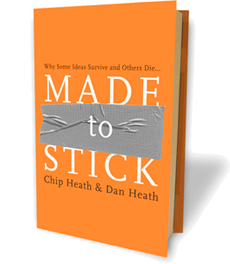
The book Made to Stick by the Heath brothers, Dan and Chip, is a safari tour of the elements of effective messaging. What is it that makes certain ideas resonate and survive while others immediately fade? Not surprisingly, the messages from the book themselves stick well and there were a ton of great stories with nuggets of insight in each.

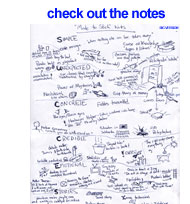
Rather than try to hash through everything in a long post as I did with Buzzmarketing, I figured I’d try a different approach. I captured the notable stories on a single page via doodles that trigger a memory of each story and its meaning. I’ve scanned that page and created an image-mapped graphic with a text snippet summarizing each insight.

The most interesting takeaway for me in reading this book is a “meta” realization that came not from anything particular within the book but rather from thinking about this book in relationship to other marketing books I’ve read (Anatomy of Buzz, Buzzmarketing, Freakonomics and Tipping Point). A discussion of that relationship merits it’s own post but the critical insight here is that for a message to be re-transmitted it must first stick with the recipient. The achievement of the sticking factor is a prerequisite for buzz-worthiness to ever be possible (ie. a virus endowed with traits that make it highly contagious will have zero effectiveness if it can’t survive within the host long enough to be spread).

The takeaway is that we spend a great deal of energy trying to spread the word when we would be better served to improve the longevity of the word for the people that it reaches. It’s not what you come away with that ultimately matters- it’s what stays with you over time. Along the lines of a post I wrote awhile back called “If an elevator pitch falls in the woods…” – the weakest link of the re-transmissability of a message is its stickiness, not its buzz-worthiness. The notes I drew up from reading Made to Stick are mostly for my own edification of these concepts and to have a reference for the future, but hopefully you find them useful as well.

Aug 21

BuzzMarketingCover.gif If you like Seth Godin’s philosophy and the main message of Purple Cow you’ll dig Buzzmarketing. In a world of advertising in which we are deluged with thousands of sound bites and ads competing for our attention, the most successful marketing campaigns are the ones that achieve buzzworthiness and propel themselves beyond the initial transmission via word-of-mouth. Doug Hughes says the key to marketing is giving people a message that’s worthy of talking about. And I couldn’t agree more. Anybody who is able to convince an entire town in Oregon to rename itself to Half.com and literally put a company on the map gets my ear for a day. Here are the key points and takeaways from reading this book.

The six buttons

Hughes believes there are six traits of buzzworthy topics. If you find a way to incorporate a couple of these qualities in your messaging, you stand a good chance of having other people passing it along. By nature we like to talk about:

  • the Taboo
  • the unusual
  • the outrageous
  • the hilarious
  • the remarkable
  • secrets
  • Basically we like to be interesting. Couch your messaging in way that lends itself to 2-3 of these qualities and it becomes “conversation currency.” Hughes explores a couple marketing success stories to substantiate this theory. For instance Miller Lite was hugely trailing its competitor Budweiser until their marketers found their sweet spot in positioning the brand. From conducting ol’ fashioned face to face market research studies in bars they learned that most bar patrons weren’t truly concerned with calories, they instead gravitated towards a specific light beer because it made them less bloated so they could stay longer at the bar. Once they discovered this hot button, Miller crafted its messaging around this aspect and then delivered an ingenious marketing campaign around the idea of “tastes great, less filling.” It became such a popular refrain that it was literally sung by fans in stadiums everywhere and Miller became the 2nd most popular brand of beer in the world.

    Hughes recounts the story of a chiropractor in New York that built a multi-million dollar practice by working on homeless people for free. That’s impossible you say? He recognized the value of word-of-mouth advertising and what occurs when you truly improve the quality of life for a few people requiring only the payment of lip service. By deferring cash payment for the first year he was able to build a massive grass roots awareness of his practice and book as many as 10x the number of clients his competitors had. He established offices that allowed him to treat people on a massive scale and eventually gobbled up competitors that defected from their own practice to join his.

    Hughes dissects the success of the TV show American Idol and how it was able to achieve impossible growth in viewership season after season in spite of the fact that every network but one had shot it down initially. Citing a Bonnie Rait song (which I despise btw), he pounds home the point that as marketers our job is simple: “let’s give ‘em something to talk about.” His analysis of the American Idol show, the community that developed around it and the countless water cooler conversations it has spawned reminded me a lot of the TV show “Friends” that was popular ten years ago when I was in college. There were social groups of people in every dorm that would spontaneously gather around the TV in the common areas to watch this show and at every commercial they would dive into lively conversation around the characters of that show. Complete strangers were united by their connection to the characters in this show. It was like meeting someone and having a mutual friend. What the makers of that show (and every other successful TV show like it) realized is that in the end people just want to connect with others. The show The Office on TV now is the current equivalent providing office workers with this shared common experience that reaches them on an emotional level. Marketers that continue with traditional techniques of blasting loud messages will eventually find that their target constituency has long ago donned noise-canceling headphones and are happily chatting away with each other via skype about the next product that shares one of the six traits of buzzworthiness.

    A major takeaway for me here was his point about “empowered interactivity” – American Idol single-handedly did for SMS text messaging what a failed $120-million dollar ad campaign around the mLife product could not do for AT&T. Give the people that use your stuff a way to show off their own intelligence via ratings, reviews, case studies, testimonials, whatever and they will become much more invested in your product. One-third of the people that voted on American Idol had never texted before the show- it was a compelling enough use case to drive 7 million people to adopt SMS. And all just so they could have a say in who won a contest on TV. The point is: do what Kathy Sierra preaches and recognize that it’s not about you, it’s about helping your users kick ass.

    The story of the Apple 1984 Superbowl commercial that catapulted the Macintosh to mainstream popularity could probably be a book on its own. Not only did that single ad (which again was initially killed by the company’s Board) resuscitate a struggling company, it arguably created the Superbowl Sunday ad pageant that’s become a yearly tradition for marketers to show off the best-in-show of advertising.

    Capture Media

    It’s no secret that the more newsworthy you become, the less you have to push things uphill via paid marketing initiatives and the more you get to enjoy the downhill toboggan ride of the press writing about you. Hughes believes there are five hot buttons for reporters, and they are stories that:

  • have a David and Goliath theme
  • are unusual or outrageous
  • incite controversy
  • include a celebrity
  • play on an already-hot topic in the media
  • So this isn’t an Einstein, ground-breaking discovery here but he retells the story of Clearplay DVD and how they drove a successful marketing campaign that consisted entirely of legal fees. This company was one of a dozen that produced a “vchip-like” technology for DVD’s that allowed parents to selectively screen out unsuitable content for their children based on thresholds defined by Clearplay. While every competitor yielded under impending lawsuits from the major Hollywood directors and studios, the Clearplay CEO saw the David & Goliath controversial showdown over the home remote and went for the jugular. The press ate up the story and people began to rally around the call of “who controls your remote, Hollywood directors or you?” In the face of copyright lawsuits from heavyweights like Spielberg who said “you’re damaging the artistic integrity of my work by altering it,” Clearplay struck a nerve with parents, kept to its story and ultimately triumphed winning major deals with studios and distributors. Hughes relates a nearly identical David & Goliath story around Ben & Jerry’s ice cream.

    My only problem with this reasoning is that, “history is written by the victors.” No arguments that taking a bold stand is going to make you newsworthy, but it also makes you a big frickin’ target for the opposition and sometimes Goliath wins in those situations. I’m reminded of the ReplayTV vs. Tivo battle and how sometimes riding in the slipstream of a competitor that chooses to lash out and absorb the brunt of the opponent’s attacks can be a more effective survival strategy. You don’t always have to outrun the bear…

    The takeaway here for JumpBox is that we need an adversary. And not an adversary as in a competitor producing virtual appliances, but adversary in terms of an iconic Goliath that our users can commiserate over and feel unified against. We had tossed around a clever idea for an ad campaign awhile back involving a “Lumberg figure” and how JumpBox was the equivalent of sawing your cube in half and gutting a fish on your desk. Sales are made when you connect with people emotionally and not from logical conclusions drawn from statistics and research. Even if you have something wildly useful, failing to connect with your market on an emotional level means you only capture people making head decisions and not gut decisions.

    Attention

    The fact you’re still reading at this point given the length of this post is laudable, so thanks for your attention. The point of this chapter is very simply: if you’re average you’re invisible. Hughes says we can do four things to better grab people’s attention:

  • follow a balanced multimedia diet for how we advertise
  • find clutter-free media – the spaces where there is nothing else competing for attention
  • take off the shine and reveal the underbelly of your organization – essentially the advice from the Wired cover story Get Naked and Rule the World
  • product placed inextricably in the content itself- think songs like “pass the courvoisier
  • There has never been as fierce a competition for people’s mental cycles as there is now. And we can expect the competition for attention to get more desperate over time. As Hughes says, “without attention nothing happens” (it’s the whole “tree falls in the woods” phenomenon). The pattern that manifests again and again in companies as they grow is that they start out with a bold approach that gets them famous and then they become complacent and reserved gravitating towards less-risky decisions- it’s essentially the Innovator’s Dilemma applied to marketing. Messaging evolves to a pasteurized, mr-potato-head-like jumble of blandness quilted together by committee. Viewers mistrust it, and more likely, stop caring altogether (kind of how we feel about Microsoft at this point).

    Supposedly in relationship counseling they say hatred is easier to resolve than apathy because at least the partner still cares and has feelings to work with. When it’s pure indifference and there’s an absence of feeling it’s impossible to fix. Same is true for a brand- it’s better to be loved or hated but when people just don’t care, then you’re hosed. Hughes delves into Britney Spears’ rise to stardom to see how her agent and publicist capitalized on attention to build her career. He recognized her talent when she was thirteen but held off on promoting her for two full years until he detected that the market was ripe for her debut. Mis-timing her launch would have almost certainly meant a fizzled career because of the scarcity of attention from the target demographic given the cycle of pop stars and that it was devoted away from poppy bands towards rock and hip hop. Obviously there was a lot more that contributed to her success than perfect timing, but launching when conditions were optimal as far as attention from the target market was a critical factor.

    Again, hindsight is always 20/20 but the takeaway here for me is that conditions now are primed for the AdSqueeze concept. Given the ADHD nature of people growing up, the fierce battle for attention and the existence of commercial-skipping technologies via DVR’s, something like AdSqueeze is sure to sprout up within the next year. And it will be a fad like Million Dollar Homepage that runs it’s course in six months, experiences a bunch of copycat competitors and then flames out. But not before somebody makes a mint on ad revenue reshapes the TV advertising landscape by offering a different model. I wish I had extra cycles and the ability to bankroll this project right now because someone will do it.

    Climb Buzz Everest

    The point of this chapter is that big wins only come with big risks. Find the Mount Everest-sized challenge that can put your company on the map and then tackle it. Hughes did precisely this with his company Half.com and persuaded a town named Halfway in Oregon to actually change its name to Half.com. Other instances of companies that climbed Buzz Everest:

    Pepsi goaded Coke drinkers to take the Pepsi Challenge after discovering from legitimate taste tests that people genuinely preferred Pepsi over Coke (the key here in this that the author neglects to mention is that Pepsi in small doses is preferable due to its sweetness – listen to a podcast from Malcom Gladwell for a discussion on this).

    The revival of Tie Dye t-shirts (and consequently the lesser-known brand of die behind them, Rit Dye) is another story of a marketing comeback from a guy that chose to ditch a comfy position marketing a sure-thing product in order to take on the impossible and climb a Buzz Everest. Doc Searls talks about effective marketing as the art of starting a forest fire of buzz by creating sparks in the right places. The Tie Dye story is a classic example of how to start a blaze by a few well-placed sparks.

    Discover Creativity

    At this point it felt like Hughes had said most of what he wanted to say and was stretching for two more chapters to round out his six points. His advice regarding creativity is to:

  • dump the idea of marketing strategy and simply define the marketing problem succinctly
  • understand your consumers intimately
  • swing the bat often and not be afraid of failure – (ie. Babe Ruth struck out more than anyone)
  • create internal competition and pit marketing teams against one another
  • produce creative content, not ads
  • He urges companies to think about failure differently- treat them like fouls in a basketball game rather than one-strike-you’re-out mistakes. When your players finish the game with four fouls that’s when they’ve pushed the limit and played their hardest. Anyone who finishes with zero fouls isn’t getting scrappy enough and taking risks. He talks about the Ford Mustang and how their marketing team did a masterful job of creating mystery around the product via “ads that hyped future ads” leaving people a secret to be discovered. Ford connected with local DJ’s and gave them individual test drives of the Mustang and then ran ad spots with the radio stations in which the DJ’s had to write their own copy for the spots relating the experience of driving the car. The result was an authentic referral from a trusted personality instead of a regurgitated sound bite from a large corporation and a product that had individuality infused into it from day one. Likewise, the Mini Cooper automobile has amassed so much personality associated with its image that 75% of their owners name their cars and 60% mod them with custom enhancements/decorations to make them more unique and personalized. When the user is that invested in the product, you can be they are going to show their friends wallet pictures of their baby.

    Police Your Product

    The last chapter is devoted to the importance of discovering and handling negative buzz early. This too seemed like brain-dead-simple common sense but Hughes points out that massive buzz blunders have caused irreparable damage to big companies. Ten years ago, the fires didn’t spread nearly as quickly because the communication means available at the time weren’t as networked and multi-media. The Internet-related technologies like web, blog, email, IM, youtube, twitter, etc. have amplified the voice of the consumer and both broadened the audience and condensed the time frame for the transmission of buzz down to seconds. Look at how quickly the Jet Blue debacle got away from them in February. Hours after being stranded on the tarmac people were taking pictures of overflowing toilets in the airplanes from their camera phones and posting them to their blog.

    Every citizen is now potentially a journalist. I learned this power first-hand through posting a negative experience on my blog after dealing with Sprint customer service. <- That blog entry has gotten thousands of visits appearing on the first page of google results for the search term "sprint customer service." As Hughes says, "23 complaints = 10,000 enemies” via the digital grapevine of communication that occurs from people posting and reading these painful stories when researching a product. Negative reviews on sites like Epinions, Yelp, Tripadvisor and Amazon cause severe material damage to companies and the smart ones have people trolling search engines to stay ontop of customer complaints made out in the blogosphere. You’re also seeing a rise of technologies like the Listening Post to monitor buzz and serve as the early warning radar so companies can detect and respond to potential PR disasters before they become catastrophic.

    Hughes says of all the survey questions companies ask, there’s really only two that matter:

  • How did you hear about us?
  • Would you be willing to go out of your way to tell a friend about our product?
  • This was a mild takeaway for me. The first tracks the effective sources of how people are finding you and your all important number: the word-of-mouth factor. The second gauges the buzzworthiness of your product and implicitly asks for a commitment from your users. We already do the first one and we’ll be implementing the second on JumpBox just as soon as I finish writing this.

    Conclusion

    If you’re into marketing, this book is worth a read. Of the handful of business books I’ve read recently, this one produced a respectable 3 1/2 takeaways and for me that factor is always the gauge of a valuable, thought-provoking read. There is one particular idea I got for a promotion which I need to run by our lawyers first. It’s so out there that I’m afraid it violates both SEC and gambling laws, but if not, you’ll be hearing about it soon enough as it will be coming second-hand to a water cooler near you.

    takeaway-half.gif
    Oct 21

    nikePlusAppliance.jpgI’ve been meaning to buy an iPod nano for awhile so I could use the Nike + running appliance to track my runs. We received Nano’s for attending the Office 2.0 conference last week in SF so I finally picked up the Nike device this week and just tried it for the first time today. All I can say is that this is what Web 2.0 is truly about. It has nothing to do with AJAX and rounded corners- it’s simple, invisible technology that bridges your real life with online and quietly improves your quality of life, gives you useful information to enhance your health, connects you with health-conscious strangers, motivates you to stay in shape and allows you to talk smack with friends on the other side of the globe all in the pursuit of better fitness.

    This little gadget is about the size and thickness of three stacked quarters and sells for $30 at the Apple store. They try to sell you the special Nike running shoes that have a divot in the sole where the appliance clips in but realistically, it works anywhere in the shoe. I just took my old running shoes, removed a few stitches from the rubber logo and sewed it into the tongue. This thing is amazing- once you calibrate it, it tracks your runs (both time and distance), can calculate calories burned and talks to you during your workout to tell you where you’re at. You can designate your power song (think your own personal Rocky theme song) and if you start slacking it automatically kicks in to motivate you to exert yourself more.

    Calibration of it was slightly annoying. I’ve never run on a treadmill before but I figured that would be the best way to gauge a mile and calibrate the device. Realistically the best way to calibrate it is to either find a known street distance or better yet, a racetrack. Once it knows your stride though, it tells you exactly how far you run. The NikePlus.com interface is slick- this is a great example of a rich interface (looks like they used Flex as the technology). The community they’re building with this service has to be extremely valuable to both companies as well- health-conscious people that aren’t just self-proclaimed but demonstrably so.

    Possibly the coolest feature is the seamless integration via iTunes with the NikePlus.com site- every time you sync your Nano, it will send the stats from your latest workouts to your account on Nike+ so you have one place where you can login and track your progress. You can also challenge up to fifty friends anywhere in the world and compare their progress with your own (smack-talking is always the best motivator for improvement). The Nike / Apple partnership is genius on so many levels- Apple has a new product, Nike sells more of their shoes and sports apparel that integrates, Apple sells entire workout playlists of celebrity athlete’s’ favorite workout songs complete with voiceovers to inspire the runner, both get access to a valuable community.

    NikePlusWebInterface.gif

    If you have friends with Nano’s that run, this is an affordable Christmas/Kwanzaa/Hanukkah gift they will never forget.

    Oct 12

    office20Conference.gifThe conference here in San Francisco is winding down and I wanted to share a random collection of thoughts in no particular order.

    The Good

    As always it’s the hallway conversations at these events that are by far the most valuable bits. There were a good number of companies here (~20?) and I was able to meet the principles of just about all of them and talk with them about what challenges they have in delivering their products. There seems to be an energy in the air perhaps due to the YouTube acquisition earlier this week that indicates tech investments are once again where it’s at. So this is an exciting time to be in this field. There were a few demos that caught our interest for apps like SystemOne, Vyew and SmartSheets that look really interesting. And meeting the guys who built WordPress and Tech Dirt was very cool.

    The Not-so-good

    I hated the term “Web 2.0″ but I realize I hate the term “Office 2.0″ even more. If I’d have charged the conference sponsors a nickel for each mention of this term throughout the panels, I’d have recouped my entrance fee and have our second round of funding for JumpBox. Far too many of the demos given here showed off these me-too MS-copycat products ported to the web with a bunch of slick AJAX features. While this might have turned me on a couple years ago for the implementation details of how they pulled it off technically, it now feels like “features for features’ sake” and smells “bubblish” in this sort of silly exuberance over things that really aren’t that cool. To me the real productivity gains to be made in an office come from not having to think about software at all, getting rid of the lame problems that plague IT departments and, if done right, getting rid of the IT department itself. Gains will be made as we learn to unearth the underground insight of the organization that locked away in the form of unapplied knowledge. I’m way more excited about apps like InklingMarkets and the proposition of bringing the power of internal prediction markets to the office than I am about authoring a word doc within the browser. I just feel like most of the companies hawking their wares here are missing the boat.

    That being said, I don’t discount the value of better tools for collaboration. I just think that if I were running a larger company and had $10k to invest towards the goal of improving our productivity, I would spend zero on software apps and instead train all my employees on how to use David Allens GTD program, give them an incentive bonus for whoever comes up with the most innovative/effective improvement and then turn them all loose with an in-house instance of Trac/SVN to use in collaborating. The apps that did catch my eye here:

    • Vyew – a slick way to do a shared whiteboard synchronously as well as asynchronously
    • Koral – painless knowledge management
    • SystemOne – an intelligent self-building wiki
    • SmartSheets – a better method for excel/email-based project management
    • oDesk – be Big Brother for your outsourced development efforts

    Beyond those, the other apps I looked at really appeared to be just minor enhancements to existing ideas with little innovation. The new Tech Insight Commnity thing is interesting- essentially a way to disrupt expensive research from analysts like Forresters, Gartner’s and Cahner’s InStat by drawing upon cheap, qualified labor of bloggers around the world.

    Eighty percent of the demos were sub-par unfortunately. I’m thinking there really might be a market for pitching yourself as a hired gun who can effectively demo a company’s product and grab the audience, because apparently most CEO’s are inherently bad at it. Most of the speakers were so immersed in the features of their own product, they dove into this highly-technical tutorial of the guts of how their products work rather than establishing that emotional connection with the audience members for why they should even be listening in the first place. That coupled with some connectivity issues due to sharing wireless with the conference attendees and a rare server outage for google mail (which everyone seemed to be using as the example email service) made some of the demos really painful.

    To summarize though- some great people in attendance, a bit of a confused message (please please please let’s drop the 2.0 suffix on terms), good energy and vibe in general. Let’s just remember that the best technology are the ones we never notice (the refrigerators, the air conditioners, the airbags, the backup generators). Office 2.0 should be about simplifying not complicating the role of tech in the workplace.

    preload preload preload